How Much Can a Rideshare Driver Realistically Make Per Week?
If you're thinking about becoming an Uber or Lyft driver in Georgia, one of the first questions you'll probably ask is:
"How much can I realistically make per week?"
The honest answer is that there is no single weekly number that applies to every driver.
Your income can change based on:
How many hours you drive
Where you drive
When you drive
How many trips you complete
Rider demand
Tips
Promotions and bonuses
Fuel costs
Vehicle expenses
Rental costs, if you use a rental car
How efficiently you manage your driving time
For drivers in Atlanta and the surrounding Georgia market, there is useful current data that can help put realistic expectations around weekly earnings.
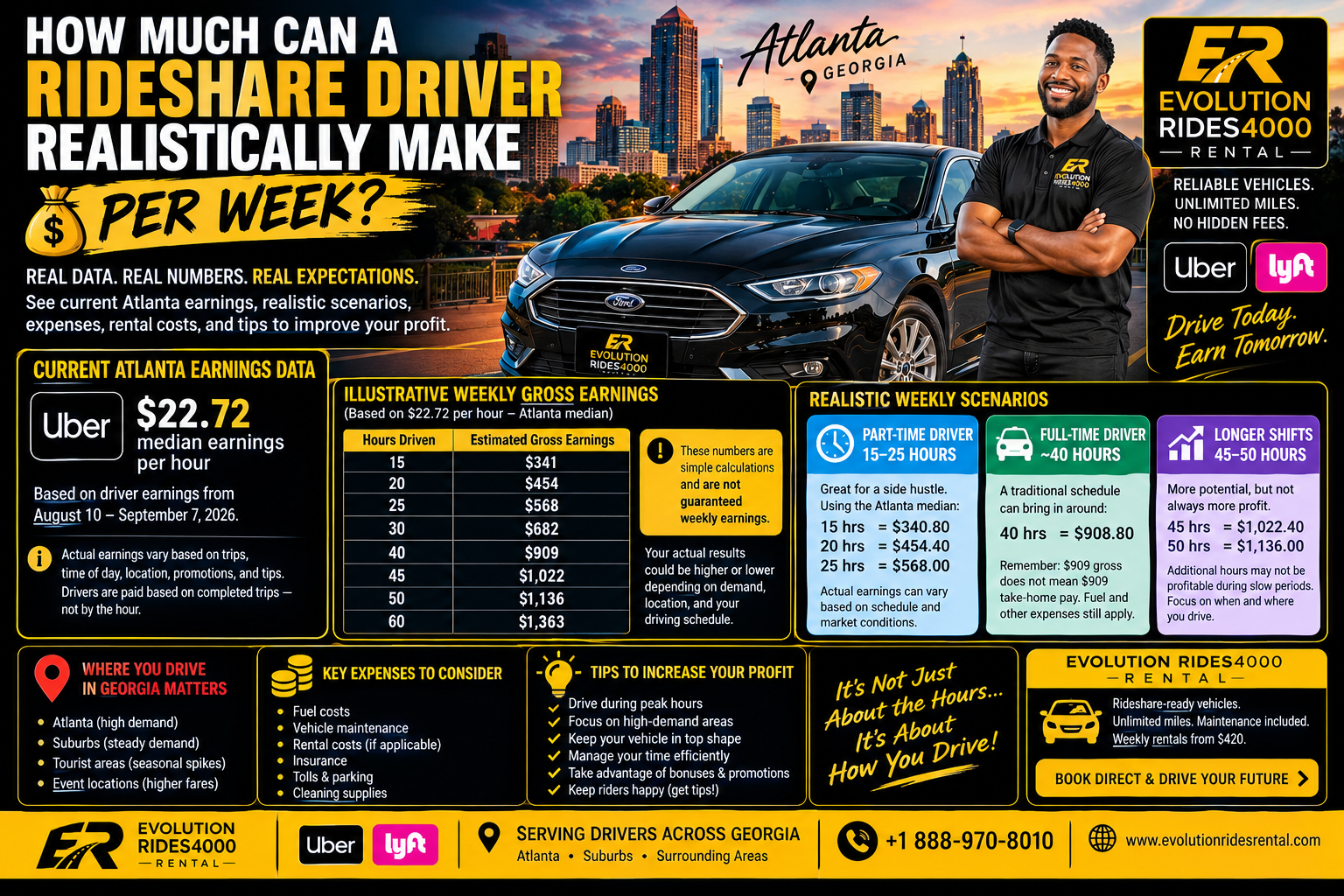
Uber currently reports a $22.72 median earnings figure per hour for Atlanta drivers, based on driver earnings from August 10 through September 7, 2026. Uber also emphasizes that actual earnings vary based on trips, time of day, location, promotions, and tips, and that drivers are paid based on completed trips—not by the hour.
That gives us a useful starting point.
But there is an important distinction:
Gross earnings are not the same as profit.
A driver can bring in $900 or $1,200 in a week and still have significantly less money left after fuel, vehicle costs, rental payments, and other business expenses.
Let's break it down.
💵 How Much Can a Rideshare Driver Make in Georgia?
There is no guaranteed weekly income for Uber or Lyft drivers.
However, current Atlanta data gives us a reasonable reference point.
Uber's current Atlanta driver page reports a median of $22.72 per hour based on the specified August–September 2026 period. This is a median—not a promise, minimum, or guaranteed hourly wage.
Using that figure only as an illustrative calculation, we can estimate what different weekly schedules would look like:
Hours Driven | Illustrative Gross Earnings at $22.72/hr |
|---|---|
15 hours | $341 |
20 hours | $454 |
25 hours | $568 |
30 hours | $682 |
40 hours | $909 |
45 hours | $1,022 |
50 hours | $1,136 |
60 hours | $1,363 |
These numbers are simple calculations using the published Atlanta median.
They are not guaranteed weekly earnings.
Your actual results could be higher or lower.
For example, a driver who spends a large portion of the week online during periods of strong demand may have a different result from someone driving mostly during slower periods.
📊 What Does a Realistic Weekly Income Look Like?
Instead of focusing on one number, it is more useful to think about different driving schedules.
🚗 Part-Time Driver: 15–25 Hours
A driver working around 15–25 hours per week might use rideshare driving as a side hustle.
Using Atlanta's current $22.72 median figure as an illustration:
15 hours × $22.72 = $340.80
20 hours × $22.72 = $454.40
25 hours × $22.72 = $568.00
Again, these are gross calculations based on the current Atlanta median—not guaranteed results.
A part-time driver's actual weekly earnings can vary significantly depending on the schedule and market conditions.
🚘 Full-Time Driver: Around 40 Hours
A traditional 40-hour schedule produces another useful benchmark.
40 hours × $22.72 = $908.80
That means an Atlanta driver working 40 hours could use roughly $900 in gross weekly earnings as a current illustrative benchmark based on Uber's published median.
But remember:
$909 gross does not mean $909 take-home pay.
Fuel and other expenses still have to come out.
This is where many new drivers make a mistake.
They see the number in the driver app and assume it represents their profit.
It doesn't.
🔥 What About Drivers Working 45–50 Hours?
Drivers working longer schedules may have the opportunity to generate more gross earnings.
At the same illustrative Atlanta median:
45 hours × $22.72 = $1,022.40
50 hours × $22.72 = $1,136.00
However, simply adding hours does not automatically make every additional hour profitable.
A driver could spend an extra five hours online during a slow period and earn less per hour than during a high-demand period.
That is why experienced drivers pay attention to when and where they drive, not just how many hours they work.
📍 Where You Drive in Georgia Matters
Georgia is a large state, and rideshare demand is not identical everywhere.
The Atlanta metro area has a much larger rideshare market than many smaller communities.
Uber specifically promotes Atlanta as a market with thousands of riders requesting trips, and its current Atlanta earnings page identifies a $22.72 median hourly earnings figure for the recent period noted above.
Lyft also explains that driver earnings can vary based on factors including trip time, distance, pickup distance, rider demand, the number of drivers available, and how busy the destination is.
That means two drivers can work the same number of hours and produce different results.
For example:
Driver A
Drives 40 hours
Works mostly during busy periods
Stays near areas with strong demand
Minimizes unnecessary downtime
Driver B
Drives 40 hours
Works mostly during slower periods
Spends significant time waiting
Frequently drives without a passenger
Both worked 40 hours.
Their earnings may still be very different.
⏰ When You Drive Can Affect Your Earnings
One of the most important lessons for a new rideshare driver is:
Not all driving hours are equally productive.
Uber explains that fares can depend on trip details and factors in the local market, including rider demand and the number of drivers available.
Lyft similarly provides drivers with tools intended to help them identify busy periods and areas, including its weekly planner and other demand-related features.
For Georgia drivers, potentially productive periods may include:
Morning commuting hours
Evening commuting hours
Friday and Saturday evenings
Weekend activity
Major events
Airport demand
Periods when demand increases relative to available drivers
However, demand changes constantly.
A smart driver should use the driver apps to monitor current demand instead of assuming that one schedule will always produce the same results.
✈️ What About Airport Driving?
Atlanta has one of the busiest airports in the country, making airport trips an important part of the local rideshare ecosystem.
Airport trips can involve longer distances and potentially higher fares, but they can also involve:
Airport traffic
Pickup procedures
Waiting time
Deadhead miles
Airport staging areas
Traffic congestion
A long trip isn't automatically a profitable trip.
The driver needs to consider total time and mileage, including the possibility of returning without a passenger.
The goal should be to evaluate the complete trip rather than simply seeing a larger fare amount.
📱 Driving for Both Uber and Lyft
Some Georgia drivers use multiple rideshare platforms.
The idea is simple:
Instead of relying entirely on one app, a driver may use both Uber and Lyft to find additional trip opportunities.
However, drivers need to manage the apps carefully.
You should not accept overlapping trips that create a situation where you cannot properly serve the passenger.
The goal is to reduce idle time—not create scheduling problems.
Using multiple platforms can also make it easier to compare available trip opportunities and understand which areas and times are productive for your particular schedule.
💰 Gross Earnings vs. Take-Home Profit
This is probably the most important section of the entire article.
Imagine you make:
$1,100 in gross rideshare earnings.
That does not mean you made $1,100 in profit.
You might still have:
Fuel
Rental payments
Vehicle maintenance
Cleaning
Tolls
Parking
Taxes
Other business expenses
Your actual profit is closer to:
Gross Earnings − Business Expenses = Amount Remaining
For example, if a driver generates $1,100 and spends $200 on fuel and $420 on a rental:
$1,100 − $200 − $420 = $480
That leaves $480 before considering other applicable expenses and taxes.
This is only an example—not a prediction of what a driver will earn or spend.
But it demonstrates why weekly gross earnings alone don't tell the full story.
⛽ Fuel Is One of the Biggest Expenses
Fuel can have a major impact on rideshare profitability.
A driver who earns more but drives significantly more miles may not necessarily keep more money.
For example:
Driver A
Earns $1,000
Spends $150 on fuel
Driver B
Earns $1,100
Spends $300 on fuel
Driver B earned more gross revenue, but the difference becomes much smaller after fuel.
That's why fuel efficiency matters.
When choosing a vehicle, consider:
Fuel economy
Fuel tank size
Typical fuel prices
Average weekly mileage
Driving conditions
Vehicle reliability
A fuel-efficient vehicle can help keep more of your gross earnings available for other expenses.
🚗 What If You Rent a Car for Rideshare?
Not every driver owns a vehicle that qualifies for Uber or Lyft.
Some drivers may not own a car at all.
Others may have a personal vehicle but don't want to put thousands of rideshare miles on it.
A rideshare rental can provide another option.
However, the rental cost needs to be included in your business calculations.
For example, if your weekly rental costs $420 and you generate $1,100 in gross earnings:
$1,100 − $420 = $680
You would then subtract fuel and any other applicable expenses.
This is why a driver considering a rental should ask:
"Can I consistently generate enough revenue to cover the rental and my other operating costs?"
That is a much better question than simply asking whether the rental is affordable.
🚙 How Evolution Rides4000 Fits Into the Equation
For Georgia drivers who need a vehicle for rideshare work, Evolution Rides4000 offers a rental option designed specifically around rideshare and delivery drivers.
Its current website lists featured vehicles at $420 per week and promotes unlimited mileage, maintenance, roadside assistance, and rideshare use.
The company's FAQ also states that weekly rentals do not require a security deposit, while its daily rental option has a refundable deposit. Current terms should always be confirmed before booking.
This can make the rental calculation easier for drivers because the weekly vehicle expense is more predictable.
Here's an example:
Suppose a driver generates:
$1,100 gross
And pays:
$420 weekly rental
That leaves:
$680
before fuel and other expenses.
If fuel costs another $200:
$680 − $200 = $480
So the driver would have approximately $480 remaining before other expenses and taxes.
The important lesson is not the specific $480 number.
The lesson is that your weekly gross earnings must be evaluated alongside your actual expenses.
📊 Example Weekly Scenarios for a Georgia Rideshare Driver
Let's look at several simplified scenarios.
Scenario 1: Part-Time Driver
Schedule: 20 hours
Illustrative gross earnings: ~$454
Possible expenses:
Fuel
Tolls
Vehicle expenses
If the driver owns an already-paid-off vehicle, the cost structure may be different from someone paying for a rental.
Scenario 2: Full-Time Driver With Personal Vehicle
Schedule: 40 hours
Illustrative gross earnings: ~$909
Possible expenses:
Fuel
Maintenance
Tires
Oil changes
Depreciation
Insurance
Taxes
Other operating expenses
The driver may have a lower weekly cash expense than a rental driver, but vehicle depreciation and maintenance still have economic costs.
Scenario 3: Full-Time Driver With a Rental
Schedule: 50 hours
Illustrative gross earnings: ~$1,136
Example rental:
$420/week
Remaining after rental:
$716
Then subtract fuel and other expenses.
This is why rental drivers need to track their numbers carefully.
A rental can remove some vehicle ownership responsibilities, but the rental payment becomes a fixed weekly business expense.
🧮 How to Calculate Your Own Weekly Rideshare Profit
Don't rely on someone else's earnings screenshot.
Calculate your own numbers.
Use this formula:
Step 1: Add Your Gross Earnings
Include:
Uber earnings
Lyft earnings
Tips
Bonuses
Promotions
Step 2: Add Your Vehicle Expenses
Include:
Rental
Fuel
Maintenance
Repairs
Parking
Tolls
Cleaning
Step 3: Calculate Your Net Before Taxes
Gross Earnings − Operating Expenses = Net Before Taxes
Step 4: Calculate Your Hourly Result
Take your net amount and divide it by the total number of hours you worked.
This gives you a much better picture of how your rideshare business is performing.
📈 How to Increase Your Weekly Earnings
Making more money doesn't always mean driving more hours.
Sometimes the better strategy is to make your existing hours more productive.
1. Drive During Productive Periods
Monitor your market and focus your schedule around periods when demand is stronger.
2. Reduce Downtime
Every hour spent waiting for trips affects your effective hourly earnings.
Lyft specifically encourages drivers to use tools that help them stay busy and identify areas with demand.
3. Learn Your Local Market
Learn:
Busy neighborhoods
Airport patterns
Event locations
Commuting routes
Restaurant districts
Major transportation hubs
Local knowledge can help you make better positioning decisions.
4. Track Your Numbers
Don't guess.
Record your:
Hours
Gross earnings
Miles
Fuel
Rental
Tips
Other expenses
After several weeks, you'll have your own data.
That data is more useful than generic earnings claims.
5. Consider Multiple Platforms
Using Uber and Lyft can give eligible drivers additional opportunities, provided the driver follows each platform's rules and manages trips safely.
6. Take Care of Your Vehicle
A vehicle problem can mean:
No vehicle → No trips → No driving income
Regular maintenance and prompt repairs help reduce avoidable downtime.
🛠️ Why Vehicle Reliability Matters to Weekly Income
Your vehicle is essentially your workplace.
If your vehicle breaks down during a busy weekend, you may lose more than the repair cost.
You can also lose:
Driving hours
Completed trips
Tips
Bonuses
Momentum toward weekly goals
That's one reason vehicle maintenance deserves to be treated as a business expense rather than an afterthought.
Evolution Rides4000 states that maintenance and roadside assistance are included with its rentals, which can help make vehicle-related expenses more predictable for eligible rental customers.
⚠️ Don't Believe Every "I Made $2,000 This Week" Screenshot
Social media is full of rideshare earnings screenshots.
You may see someone claiming:
"$2,000 this week!"
That may be completely real.
But you don't know the full story from the screenshot alone.
You may not know:
How many hours they worked
How many miles they drove
How much they spent on fuel
Whether they used a rental
How much they paid in tolls
Whether bonuses were included
Whether the week was unusually strong
Whether the amount represents gross earnings or profit
A screenshot shows a result.
It doesn't necessarily show the cost of producing that result.
That's why your own weekly records are more valuable.
📅 How Many Hours Should You Drive?
There isn't a universal number.
Some drivers use rideshare as a side hustle.
Others work full-time.
Some may drive 15–20 hours.
Others may drive 40–50 hours or more.
The important question is:
How much do you earn per productive hour after expenses?
If you discover that your fifth hour of a shift consistently produces very little compared with your first three or four hours, you may want to reconsider how you're scheduling your time.
Longer hours aren't automatically better.
Efficient hours can be more valuable than simply adding more hours.
🎯 Set a Weekly Earnings Goal
Instead of saying:
"I want to make as much as possible."
Set a specific target.
For example:
Goal: $1,000 gross per week
Then determine what that requires.
Using the current Atlanta median as a simple illustration:
$1,000 ÷ $22.72 ≈ 44 hours
That does not mean you'll automatically reach $1,000 after driving 44 hours.
Your actual earnings can be higher or lower.
But the calculation gives you a starting framework.
Then ask:
Which days should I drive?
Which hours are most productive?
How much fuel will I need?
What are my weekly vehicle costs?
What is my target net income?
Now you're treating rideshare driving like a business.
💡 A Better Goal: Track Net Earnings Per Hour
Gross earnings are useful.
But net earnings per hour can be even more useful.
For example:
Driver A:
Gross: $1,000
Expenses: $350
Net before taxes: $650
Hours: 40
$650 ÷ 40 = $16.25/hour
Driver B:
Gross: $900
Expenses: $150
Net before taxes: $750
Hours: 30
$750 ÷ 30 = $25/hour
Driver B earned less gross revenue but kept more money relative to time worked.
That's why you shouldn't judge your rideshare performance based only on gross weekly revenue.
🚘 Is Renting a Car Worth It for a Georgia Rideshare Driver?
There is no universal answer.
It depends on your driving volume, vehicle costs, and financial goals.
A rental may make sense for someone who:
Doesn't own a qualifying vehicle
Doesn't want to finance a vehicle
Wants to avoid putting rideshare mileage on a personal vehicle
Wants predictable vehicle costs
Needs a rideshare-ready vehicle
Wants maintenance support
But the rental payment must be included in your weekly business calculation.
For example, with a $420 weekly rental:
$420 × 4 weeks = $1,680
That's a significant monthly expense.
The driver needs enough gross earnings to comfortably cover that cost along with fuel and other expenses.
🚗 Why Some Georgia Drivers Consider Evolution Rides4000
Evolution Rides4000 focuses its rental service on drivers using vehicles for rideshare and delivery work in Georgia.
The company's current website highlights:
Rideshare and delivery use
Unlimited mileage
Maintenance
Roadside assistance
Weekly rental options
Rideshare-ready vehicles
Flexible rental options
Customer support
Its current featured vehicles include premium sedans listed at $420 per week, although availability and pricing can change.
For a driver, the main benefit of this type of arrangement is not that the rental guarantees higher earnings.
It doesn't.
The benefit is having access to a vehicle that can support your driving business without purchasing a vehicle upfront.
Your income will still depend on your driving strategy, demand, hours, expenses, and individual performance.
📋 Weekly Rideshare Driver Checklist
At the end of every week, record:
Earnings
Uber gross
Lyft gross
Tips
Bonuses
Promotions
Hours
Total online hours
Total engaged hours
Productive hours
Vehicle
Miles driven
Fuel purchased
Maintenance
Rental payment
Other Costs
Tolls
Parking
Cleaning
Other business expenses
Results
Calculate:
Gross Earnings
Total Expenses
Net Before Taxes
Net Per Hour
Net Per Mile
After a month, you'll start seeing patterns.
You may discover which days are most productive, which hours are worth working, and which expenses are taking the biggest portion of your income.
❓ Frequently Asked Questions
How much can a rideshare driver make per week in Georgia?
There is no guaranteed amount. Current Uber data for Atlanta shows a $22.72 median earnings figure per hour for the August 10–September 7, 2026 period. Using that figure as an illustration, 40 hours would equal about $909 in gross earnings. Actual earnings vary.
Can I make $1,000 a week driving Uber in Georgia?
It is possible for some drivers, but it is not guaranteed. Using Atlanta's current published median as a simple illustration, reaching $1,000 in gross earnings would require roughly 44 hours at $22.72 per hour. Actual results depend on trips, demand, location, schedule, promotions, and tips.
Can I make $1,500 a week driving Uber or Lyft?
Some drivers may reach that level of gross earnings, but it should not be treated as a typical or guaranteed result. The number of hours, market conditions, trip volume, bonuses, and expenses all matter.
How much does a full-time rideshare driver make in Atlanta?
Current Uber data lists a $22.72 median hourly earnings figure for Atlanta for the stated recent period. A 40-hour calculation at that figure is about $909 gross, but actual weekly earnings can vary significantly.
Is $1,000 a week good for a rideshare driver?
The gross amount alone doesn't tell you whether the week was profitable. You need to subtract fuel, vehicle costs, rental payments, tolls, maintenance, and other expenses before evaluating the result.
Does driving more hours always mean making more money?
Not necessarily. Additional hours can increase gross earnings, but slow demand, fatigue, fuel costs, and other expenses can reduce the value of those additional hours.
What is the biggest expense for rideshare drivers?
It depends on the driver. Common expenses include fuel, vehicle payments or rental costs, maintenance, repairs, insurance, depreciation, tolls, and other operating costs.
Is renting a car for Uber worth it?
It depends on your individual numbers. Compare the weekly rental cost with your expected gross earnings and subtract fuel and other expenses before deciding.
Can I use an Evolution Rides4000 vehicle for rideshare?
Evolution Rides4000 currently states that its rentals can be used for Uber, Lyft, and delivery work. Drivers should still verify that the specific vehicle and documentation meet the current requirements of the platform they intend to use.
Does Evolution Rides4000 offer unlimited mileage?
Its current website states that all rentals include unlimited mileage. Always confirm the current rental agreement before booking.
How can I make more money driving Uber or Lyft?
Focus on improving your productive hours, learning your local market, reducing downtime, controlling fuel costs, maintaining your vehicle, and tracking your actual net earnings.
Should I drive Uber and Lyft at the same time?
Some drivers use both platforms to reduce downtime and increase available trip opportunities. However, drivers need to manage the apps carefully and must not accept overlapping trips that they cannot safely complete.
Is Atlanta better for rideshare driving than other Georgia cities?
Atlanta is a major rideshare market, and Uber currently publishes Atlanta-specific earnings data. However, earnings vary by location, demand, hours, and individual driving strategy, so one city's published figure should not be treated as representative of every Georgia market.
How do I know if I'm actually making money?
Track your gross earnings, fuel, rental or vehicle costs, maintenance, tolls, other expenses, total miles, and hours. Then calculate your net earnings and net earnings per hour.
🏁 Final Thoughts
So, how much can a rideshare driver realistically make per week in Georgia?
The answer depends on how, when, and where you drive.
For Atlanta, Uber's current published data gives a $22.72 median earnings figure per hour for the August 10–September 7, 2026 period. At that rate, a simple calculation would put 40 hours at approximately $909 gross, while 50 hours would be approximately $1,136 gross. But these are illustrative calculations, not guaranteed weekly earnings.
The most important thing to remember is that gross earnings are only the beginning.
If you drive a rental vehicle, your weekly rental needs to be included.
If you own your vehicle, you still need to account for fuel, maintenance, depreciation, insurance, and repairs.
That's why successful rideshare drivers don't simply ask:
"How much did I make?"
They ask:
"How much did I keep after my expenses, and how much did I earn for every hour I worked?"
For Georgia drivers who need a rideshare vehicle, Evolution Rides4000 offers an option built around rideshare and delivery use, with current listings showing weekly rentals, unlimited mileage, maintenance, and roadside assistance.
But a rental is only financially worthwhile if the numbers work for your driving schedule.
The best approach is simple:
Track your earnings. Track your expenses. Track your hours. Then make decisions based on your own numbers.
That's how you turn rideshare driving from a simple side hustle into a business you can actually measure.